‘Chatterboxes’ is a speech & language program that is facilitated by Dublin Adult & Child Therapy Centre. Following our recent partnership with the centre, the team at head office were privileged to attend a special workshop with the Chatterboxes team which focused on language development for pre-schoolers. This workshop proved to be hugely interesting and informative for us all, not just as childcare professionals but also as parents! Therefore we would like to share what we learned with our parents in Park Academy Childcare, so that they too can benefit from the practical yet effective strategies. Here are the top 5 things that we learned from the Chatterboxes team about language development:
1) What ‘School Ready’ Really Means
The first years go so fast and before we know it’s time to start thinking about ‘big school’! When we begin to assess if a child is ‘school ready’ we tend to focus on things like:
– Can they put on their own coat?
– Do they know their colours?
– Are they emotionally ready?
However, according to Karen O’Driscoll, Speech & Language Therapist with DACT, there is one important area that needs more focus. A child’s ability to listen and follow instructions in school is also hugely important and a skill which impacts on all other areas. If a child has difficulty listening, they will find it hard to keep up with other aspects of the curriculum such as learning their sounds or their numbers. Therefore, it is important that parents prioritise this area, in order to give children the best start in school. By giving children clear and simple instructions to follow at home, we can train them to listen carefully and to process these instructions correctly. This doesn’t need to be a formal exercise – it can be easily incorporated into your everyday routine. For example, while preparing the dinner you could ask your child to help you with a simple task – ‘can you pass me the carrots from the table please?’ – so that they get used to responding to requests.
2) Keep instructions simple
However, when giving children instructions, it is also important not to include too much information. Be mindful that our instructions can sometimes be too detailed for a young child. For example an instruction such as ‘put your shoes in the green box’ may sound straightforward to us but a child must assimilate three separate pieces of information from this. Firstly, they must ascertain which shoes you mean (my shoes), next they need to process where you want them to put the shoes (the box) and then lastly they have to understand which box you mean (the green box). You can help to make this easier for a child by including the necessary information only. Breaking down instructions into shorter smaller requests also helps. Often if a child can not follow an instruction it is because it is too complicated. Clear, simple instructions work best.
3) Every day can be a lesson in language!
In order to learn more language, children must hear more language. As parents we play an important role in this area, through the natural conversations we have with our children every day. Remember that language development doesn’t just take place in formal settings such as school! Take advantage of everyday natural opportunities such as a walk to the shop or a trip on the bus. Chat to your child and create conversations that they can contribute to. Take opportunities to comment on things or situations (for example ‘Oh look at that big bus!’ ‘I’m getting a bit hungry! Will we go and get our lunch?’) so that your child learns how to express themselves and their thoughts. Communication is central to all human interactions so every day can be a valuable lesson in language! The more language your child hears the more they will absorb.
4) Expand on topics to enhance vocabulary
When speaking to your child, use any opportunities you can to expand their vocabulary. Most parents will comment on or draw their child’s attention to things but expanding on this will really enhance language development. So for instance instead of just pointing out a nest that you spot on a walk, ask your child questions like:
– ‘Who owns the nest?’
– What colour is the nest?’
– Where is the nest?!’
This way, you are encouraging your child to expand their language and giving them an opportunity to use the words that they have. They will also have a chance to practice language structure in their answers, for example by using prepositions – ‘in the tree’. If they use incorrect grammar such as ‘on the tree’ a parent can simply highlight this by repeating the correct use – ‘yes it’s in the tree’. After a while the child will pick up on this error and correct themselves naturally. These types of interactions expose children to a higher level of language than just one word statements or comments.
5) Less is sometimes more!
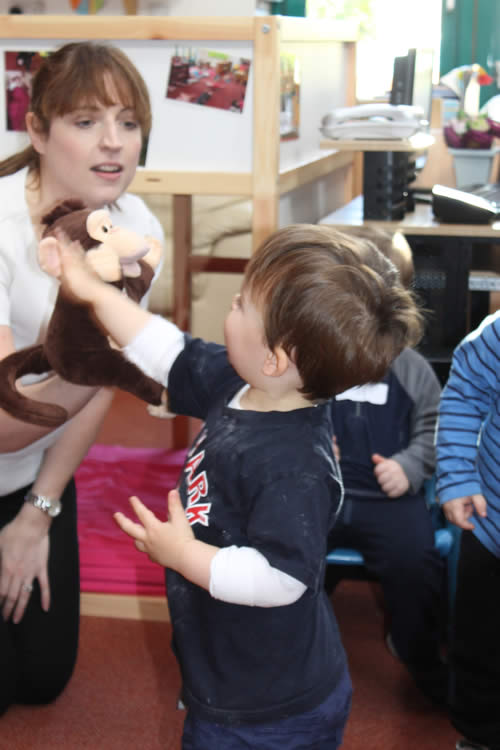
As parents, we all have a natural tendency to chat to our children and interact with them through language. However, while this is beneficial, it should not hinder a child from using their own language. For example, if we are at the Zoo and see a monkey we may comment ‘Oh look at the monkey!’ ‘See what he has in his hand?!’ ‘A banana!’ ‘You love bananas don’t you?!’ ‘Monkeys love bananas too – they are their favourite!’ ‘See what he’s doing now?!’ ‘He’s so funny isn’t he?!’ Does this sound familiar?! By keeping up a stream of constant chatter we can discourage our child from making their own observations or asking questions – both of which require them to use their language skills. As with everything in life balance is the key. It’s good to chat to your child but it is also important to give them some space to chat back!
And finally… It’s important to remember that language is central to all learning and impacts on all areas of a child’s development. Communication is a huge part of life and language difficulties can cause a child to experience anxiety or even present behavioural issues due to frustration. The ability to express themselves will give a child the confidence to interact in society, for example to ask for what they want in a shop or at a party. Therefore it is important that us parents prioritise language development and are aware of any issues that a child may be having in this area.
Our team at Park Academy Childcare have extensive experience in childcare and possess a huge amount of knowledge on child development. They are always happy to chat to a parent who has some concerns or who is seeking a bit of advice. Our partnership with Dublin Adult & Child Therapy Centre also means that we can put parents in touch with some experts should the situation require it.
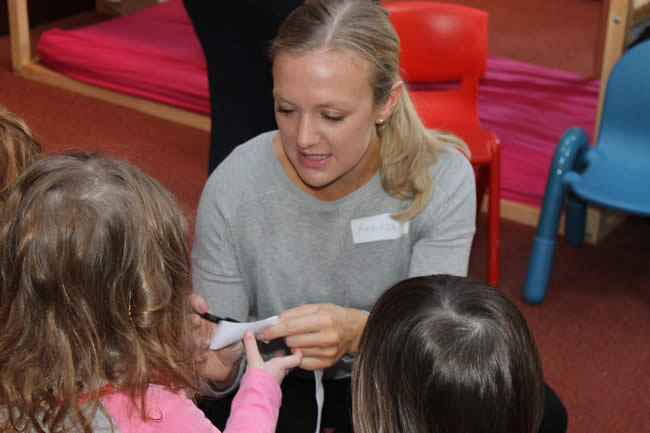
Recently a few of our centres participated in dedicated language development workshops with Dublin Adult & Child Therapy Centre, to further enhance the teams understanding of this area. The teams found these to be hugely valuable and are looking forward to implementing some new strategies in their rooms. Our Cabinteely centre also participated in a six week workshop called ‘Chatterboxes’ which focused on language develoment for the ‘Rascals’ age group. Currently we are providing various talks for parents in the area of language development, as well as in other key areas such as social development.
We are also delighted to have had the opportunity to participate in such a valuable workshop. We found it immensely informative and hope that the tips that we have shared will be of benefit to you too. Watch out for our parent talks with Dublin Adult and Child Therapy Centre which will be advertised in your crèche soon!
Kind regards,
The Park Academy Team
Dublin Adult & Child Therapy Centre provide a valuable service to parents in Dublin and surrounding areas. As well as speech and language therapy they also specialise in clinical psychology and occupational therapy. For more information on any of these services please go to their website at www.adultandchildtherapy.ie.